The number that should make you uncomfortable
As of mid-2026, publicly listed companies hold somewhere around 1.25 million bitcoin. That is close to 6% of everything that will ever exist. One company, Strategy, holds roughly 845,000 of those coins on its own, about 4% of total supply, bought for something close to $63.7 billion.
None of that is inherently bad. Bitcoin sitting on a corporate balance sheet is still bitcoin. The problem is not the holding. The problem is how the holding was financed.
Almost none of these companies bought their bitcoin out of operating profit. They bought it with capital markets: convertible notes, perpetual preferred stock, at-the-market equity programs, and in the case of the smaller imitators, straightforward secured loans. The bitcoin is an asset. Sitting behind it is a stack of claims that has to be serviced in dollars, on a schedule, whether or not bitcoin cooperates.
That is the risk. Not that these companies own bitcoin, but that a meaningful slice of the supply now sits behind a dollar-denominated liability structure that does not care about four-year cycles.
The model in one paragraph
The Saylor model is elegant, and I say that as a criticism as much as a compliment. A company announces it will hold bitcoin as its primary treasury asset. Investors who want leveraged bitcoin exposure inside a brokerage account bid the stock above the value of the bitcoin it holds. That premium is the whole engine. The company then issues new shares into that premium, buys more bitcoin with the proceeds, and because it sold shares at more than the underlying bitcoin was worth, bitcoin per share goes up. Existing shareholders get diluted in share count and enriched in bitcoin terms at the same time. It looks like free money, and while the premium holds, it functionally is.
The number that governs all of this is mNAV, the multiple of net asset value. Above 1.0, issuing stock adds bitcoin per share and the flywheel spins. Below 1.0, the same issuance subtracts bitcoin per share. The engine does not slow down at that point. It reverses.
Where the leverage actually sits
This is the part most commentary gets wrong in both directions. The bears imagine margin calls. The bulls insist there is no leverage risk at all. Neither is right.
It is not a margin loan
Strategy's debt is unsecured and long dated. The bitcoin is not pledged as collateral. No lender holds the keys, and no counterparty has the contractual right to liquidate the stack if bitcoin trades below some threshold. Saylor has made this point repeatedly, and he is correct on the mechanics: there is no price at which someone else sells his bitcoin for him. His claim that liquidation risk only appears somewhere near $8,000 per coin is directionally defensible for the debt specifically.
If the risk were a margin call, we would already have seen it. Bitcoin is trading near $80,000 against a company average cost around $75,000, and nothing has been seized.
It is a perpetual cash obligation
Here is what replaced the margin call. Strategy's own disclosures put annual interest plus preferred dividends at roughly $1.7 billion. The preferred series are perpetual, which means there is no maturity date at which the obligation goes away, and the variable rate series has been paying in the 11% to 12% range. Against that sits a software business whose operating cash flow is a rounding error next to the number.
So the question is not "who can force a sale." The question is "where do the dollars come from." There are only three answers: sell more securities, hold a cash reserve raised from previously selling securities, or sell bitcoin. All three depend on the capital markets staying open, and the capital markets stay open because of the premium.
That is a softer constraint than a margin call, and a slower one. It is not a weaker one. A margin call is a cliff. This is a tide.
What happens when the flywheel runs backwards
Trace the loop in reverse and it is uncomfortably tight.
Bitcoin falls. The stock falls faster, because leverage cuts both ways and because the premium itself deflates. mNAV drops through 1.0. Issuing equity now destroys bitcoin per share, so the company either stops issuing or starts actively harming the metric it markets itself on. The dividend and interest bill does not stop. The cash reserve drains. Eventually the only remaining source of dollars is the bitcoin itself.
And the company sells bitcoin into a market that is already falling, which pressures the price, which pushes the stock lower, which widens the discount, which makes issuance even more destructive. That is the loop critics call the doom loop, and while the label is dramatic, the mechanism is real corporate finance, not conspiracy.
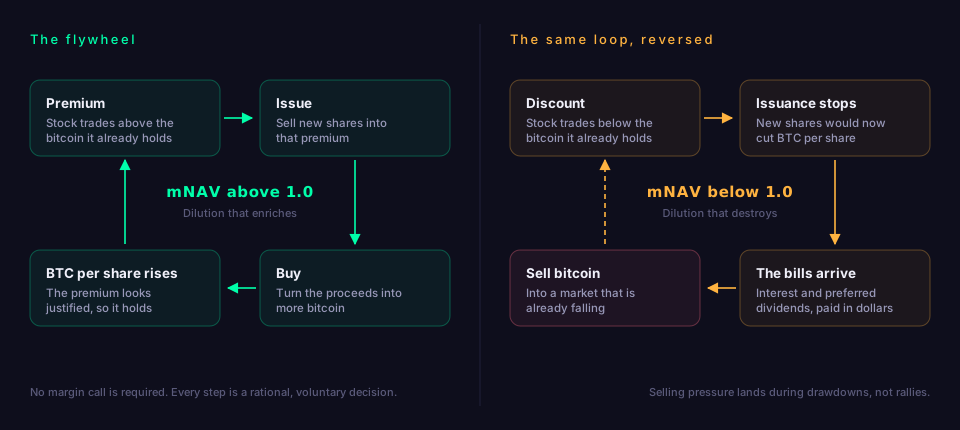
Note that at no point does anyone need to be forced. Every step in that sequence is a rational, voluntary decision by management doing its job.
2026 stopped being theoretical
Everything above was a whiteboard argument until this year. It is not any more.
Bitcoin is down roughly 36% from its October 2025 high near $126,000. That is a completely ordinary drawdown by bitcoin's standards, milder than 2018 and far milder than 2022. The treasury sector did not survive it in ordinary fashion.
In late May, Strategy sold 32 bitcoin, about $2.5 million worth. A trivial amount, and the most important trade of the year. It was the company's first disclosed disposal since 2022, and the stated use of proceeds was to pay the dividend on its variable rate preferred stock. Between late June and mid-August, the sales grew to roughly 7,000 bitcoin for about $430 million. The company also adopted a new capital framework explicitly authorising up to $1.25 billion of bitcoin sales and $2 billion of buybacks. On the Q1 call, after reporting a $12.5 billion net loss, Saylor described selling some bitcoin to fund a dividend as a way to inoculate the market.
The company that defined "never sell" wrote a selling policy. That is the model updating itself in public.
Down the quality curve it was worse. Sequans sold 1,025 bitcoin and then disposed of roughly 80% of what remained to repay convertible debt. Nakamoto sold 600 coins to clear a $45 million creditor and another 284 for working capital. Satsuma's board voted to wind down trading operations and sell its stack outright. VanEck counted at least 20 public treasury companies that have liquidated, reduced, or quietly loosened their accumulation mandates.
In July, the fifty largest corporate holders were net sellers of bitcoin for the first time. Not by much, around 2,500 coins. Direction matters more than magnitude here.
The equity damage is the loudest signal. The top fifty treasury companies have lost roughly $80 billion of combined market value in thirteen months, from about $150 billion down to $67 billion. Forty-three of those fifty now trade below the price bitcoin was at when they announced their first purchase. Thirty-five are down more than half. Around 40% of the top hundred trade below the value of the bitcoin they hold.
Strategy itself is instructive. Its bitcoin is worth roughly $68 billion. Its market capitalisation is roughly $55 billion. On a basic share count the stock trades at about 0.81 times its bitcoin, a 19% discount. Measured on enterprise value, which adds back the debt and preferred stock, it is still slightly above 1.0. Both numbers are true, and the gap between them is precisely the value the market now assigns to the claims stacked ahead of common shareholders.
Why this is a bitcoin problem, not just a shareholder problem
You can argue that all of this is fair punishment for people who bought leveraged equity instead of coins. Partly true, and it misses four ways the damage leaks into bitcoin itself.
The selling is correlated with weakness by design. These companies do not sell into strength. They sell when the premium is gone, the reserve is drained, and the dividend is due, which is exactly when bitcoin is already under pressure. A holder who sells for idiosyncratic reasons adds noise. A structurally motivated seller who only appears during drawdowns adds depth to drawdowns.
Concentration is now a market structure fact. Roughly 4% of supply sits on one balance sheet carrying a $1.7 billion annual cash obligation. Even if that entity behaves perfectly, its policy decisions are now a bitcoin market event. That is a new dependency bitcoin did not have in 2019.
The imitators are the fragile part. Strategy has long-dated unsecured debt, deep capital markets access, and a founder with unusual conviction. The 150-plus companies that copied the pitch mostly have none of that. They have secured facilities, short maturities, small floats, and no real operating business underneath. They do not bleed, they snap, and they snap all at once because they are all levered to the same asset with the same trigger.
Bitcoin's price now touches equity market plumbing. In December 2025, MSCI proposed excluding companies whose digital assets exceed half their total assets from its global indexes. JPMorgan estimated that MSCI acting alone would force roughly $2.8 billion of passive selling in Strategy shares, and up to $8.8 billion if other index providers followed. MSCI declined to act in January 2026, so nothing happened. Read that again: bitcoin sentiment for a week hung on an index committee's classification decision. That linkage was created entirely by the treasury company model, and it has been deferred rather than removed.
There is a fifth cost that is harder to measure. For two years, "corporate adoption" was the institutional bull case. What actually got adopted, in most cases, was a leveraged carry trade wearing bitcoin's logo. When 43 of 50 of those companies end up underwater, the retail investors who bought them as bitcoin proxies do not conclude that they picked bad wrappers. They conclude that bitcoin failed them. That is a narrative cost bitcoin pays for someone else's balance sheet.
The honest counterargument
I do not think this ends in a cascade, and the steelman deserves a fair hearing.
The sales so far are tiny. Seven thousand coins out of 845,000 is under 1% of one company's stack, and bitcoin's spot market absorbs that kind of flow routinely. Strategy's converts are unsecured and long dated, several can be settled in shares rather than cash, and management has been actively retiring some of them early. Buybacks below NAV are genuinely accretive to bitcoin per share, which means a discount creates its own repair mechanism. Metaplanet reached the same conclusion from the other side of the world and authorised a repurchase of up to 13% of its shares specifically because mNAV fell under 1.0.
There is also a cleansing argument. Weak, over-levered copycats getting liquidated is how a sector removes bad structures. The coins do not disappear. They move from levered corporate balance sheets to buyers who wanted them at that price, which is a healthier distribution than the one it replaces.
So the realistic base case is a slow grind rather than a crash: years of mild, persistent, drawdown-correlated supply from companies managing their liabilities, punctuated by fast liquidations at the low-quality end. Not an extinction event. A structural headwind that did not exist before, sitting on top of a supply base that used to be dominated by holders with no obligations at all.
Seven questions to ask about any treasury company
If you are looking at one of these as an investment, or just trying to gauge how much supply overhang the sector represents, these are the questions that actually separate the survivors:
- Is the debt secured or unsecured? Pledged bitcoin means someone else decides when you sell. This is the single biggest quality divider in the sector.
- When are the maturities and put dates? A 2030 maturity is a different animal from a 2027 put. Map the calendar before you map the thesis.
- What are annual cash obligations versus non-bitcoin operating cash flow? If interest plus dividends dwarf the operating business, the bitcoin is the funding source by default.
- Where is mNAV, and for how long? A week below 1.0 is noise. Two quarters below 1.0 means the issuance engine is off and something else has to pay the bills.
- Is bitcoin per share still rising? This is the only metric that proves the model is working. If share count grows faster than the stack, you are watching dilution with a bitcoin theme.
- Have they amended the "we never sell" policy? Companies write selling frameworks shortly before they sell. Strategy did exactly that.
- Is there a real business underneath? Operating cash flow is the difference between riding out a bear market and becoming a forced seller in one.
What this means if you actually own bitcoin
The coin does not care about any of this. Twenty-one million is still twenty-one million, blocks still arrive, and none of the mechanics above touch the protocol. But the market you buy and sell in has changed shape, and it is worth being clear-eyed about how.
A treasury company is not a bitcoin proxy. It is a bitcoin-flavoured credit trade. You are long bitcoin, short a preferred dividend stream, long management's capital allocation, and long continued access to equity markets. Sometimes that stack pays you more than bitcoin does. In 2026 it has paid most holders considerably less, and 43 of 50 of them are still underwater against the price of the coin on the day they started.
If what you want is bitcoin, the boring answer keeps winning: buy spot, hold your own keys, and accept that you will not get the flywheel. You also will not get the dividend bill when the flywheel stops.
And if you hold no treasury equities at all, this still matters to you as a market participant. You now share a market with a class of holder that has to sell on a schedule, in drawdowns, for reasons that have nothing to do with bitcoin. Price that in. It is not a reason to be bearish on bitcoin. It is a reason to stop treating corporate treasury announcements as unambiguously bullish news.
The single greatest source of bitcoin selling pressure over the next two years is unlikely to be a hack, a ban, or a hard fork. It is far more likely to be an accounting department, on the fifteenth of the month, wiring a dividend.
This is analysis, not financial advice. Do your own research and manage your own risk.